At a glance
- Skill
- Speaking
- Preparation time
- 30 seconds
- Time to speak
- 1 min
What you need to do
In Speaking Task 3, you see a picture of an everyday scene, like a park, a store or a family kitchen. You describe the picture to someone who can't see it, so they can imagine it.
There is a lot to talk about in every picture, so the challenge isn't finding ideas. It's choosing the most important things, describing them in a clear order and using precise words instead of "thing" and "stuff".
Task 4 uses the same picture, so a good look at the scene now helps you in the next task too.
What you'll see on the test
- 30 seconds to prepare, then 60 seconds to speak.
- The picture stays on the screen while you prepare and while you speak.
- The task says the person you are talking to can't see the picture.
- Recording starts and stops automatically.
What the test is looking for
Content and coherence
A short overview of the scene, then the main people and actions, described in a clear order so the listener can follow.
Vocabulary
Precise words for places, objects, clothes and actions, and words for position like "on the left" and "in the background".
Listenability
How easy you are to follow: speaking smoothly without long pauses, clear sentences and good grammar control.
Task fulfillment
Describing what is really in the picture, with enough detail that someone who can't see it can picture it, for most of the minute.
Step-by-step strategy
- 1
Find the big picture first
In the first few seconds, ask yourself: where is this, and what time of day or year is it? That becomes your first sentence.
- 2
Choose three or four main things
Pick the people and actions that stand out most. You don't have time to describe everything, and you don't need to.
- 3
Plan a route through the picture
Go left to right, or from the front to the back. A fixed route stops you from jumping around and makes you easy to follow.
- 4
Use the present continuous for actions
"A boy is playing hockey." "A woman is tying her skates." This is the natural way to describe what people are doing in a picture.
- 5
Add details that help someone picture it
Colours, clothes, the weather and how people seem to feel turn a list into a scene: "a girl in a red jacket who looks really happy".
- 6
Finish with the mood
If you have time left, end with one sentence about the feeling of the scene: "It looks like a calm, happy winter afternoon."
Useful phrases
The big picture
- “This picture shows…”
- “It looks like it's taking place in…”
- “It seems to be a… day.”
Where things are
- “In the middle of the picture, …”
- “On the left / On the right, …”
- “In the background, …”
- “In the front, close to us, …”
- “Next to… / Behind… / Across from…”
People and actions
- “There's a man who is…”
- “A girl in a red jacket is…”
- “Two children are…”
How things seem
- “She looks…”
- “It seems like…”
- “They're probably…”
Common mistakes
Listing objects without saying what is happening.
"There is a bench. There is a dog." is weak. Say what people and animals are doing: "A dog is running onto the ice."
Jumping around the picture.
Choose a route, like left to right, and stay with it. The listener can't see the picture, so order matters.
Spending the whole minute on one person.
Plan three or four main things before you start, and give each one about 10–15 seconds.
Predicting the future too early.
Task 3 is about what is happening now. Save "what will happen next" for Task 4.
Using vague words.
Say "a hockey stick" or "a wooden bench", not "a thing" or "something to sit on".
Example with answer
Example 1
Task
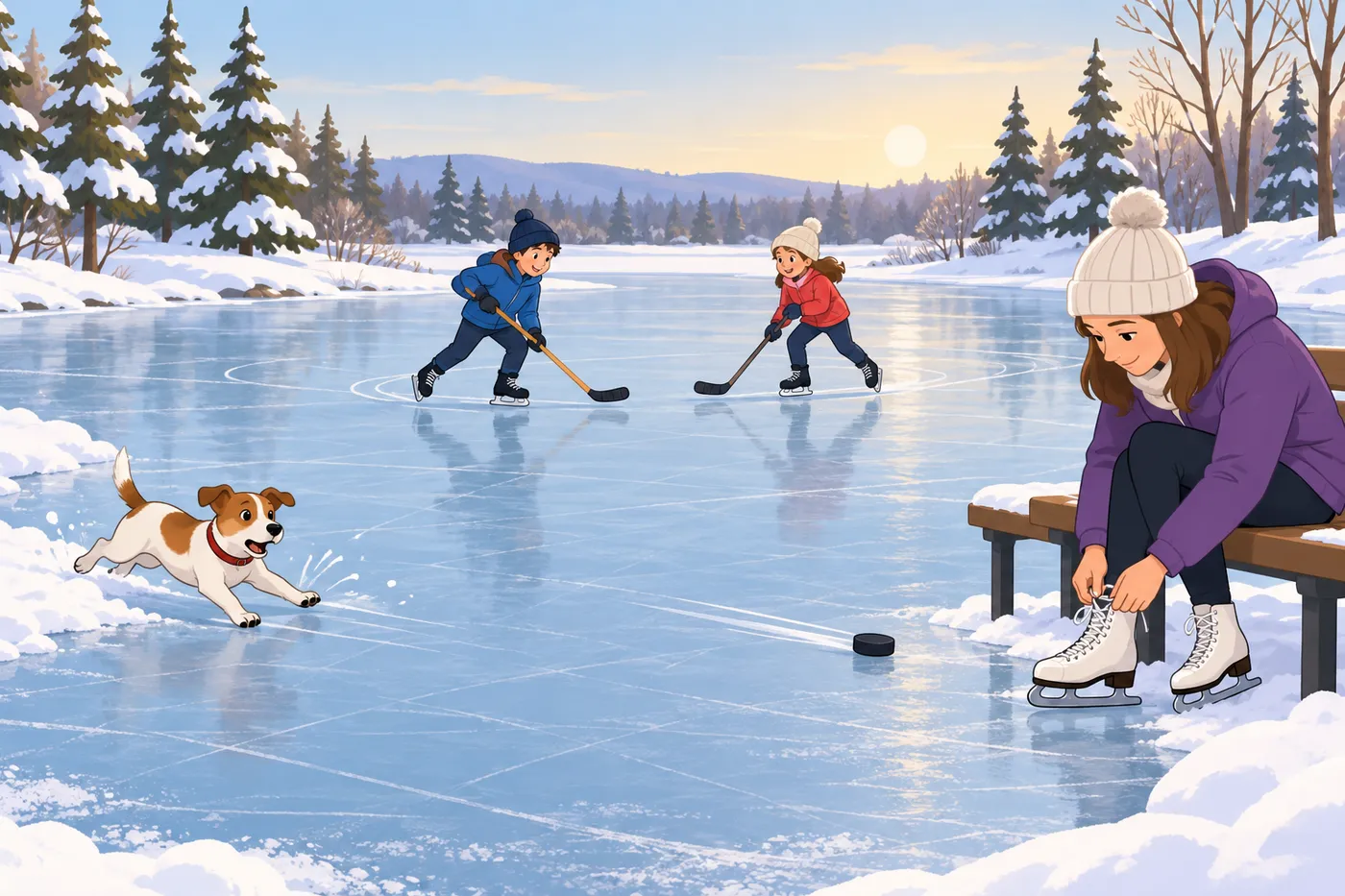
Describe some of the things that are happening in this picture as well as you can. The person you are talking to cannot see the picture.
Sample answer (what the speaker says)
This picture shows a frozen pond in a park on a winter afternoon. There's a lot of snow on the ground and on the pine trees, and the sun is low in the sky, so I think it's late in the day. In the middle of the pond, two children are playing hockey. On the left, there's a boy in a blue jacket and a dark blue toque, and across from him there's a girl in a red jacket and a white hat. They both have hockey sticks, and they look like they're having a lot of fun. On the right side of the picture, a woman is sitting on a wooden bench at the edge of the ice. She's wearing a purple jacket and a white toque with a pom-pom, and she's tying her white skates. She looks calm and happy. In the front, on the left, a small brown and white dog with a red collar is running onto the ice. Its legs are sliding, so it's slipping a little. Overall, it looks like a peaceful, happy winter day outside.
Why it works: The speaker starts with the big picture (where, when and the weather), then moves through the scene in a clear order: the children in the middle, the woman on the right and the dog in the front. Each person has clothes, an action and a feeling, so the listener can picture them. The speaker describes what is happening now and saves predictions for Task 4. It fills about 60 seconds.
Questions students ask
How long is CELPIP Speaking Task 3?
You get 30 seconds to prepare and 60 seconds to speak.
Do I have to describe everything in the picture?
No. Describe the main people and actions clearly and in a good order. Three or four things described well are better than ten things listed quickly.
Which tense should I use?
Mainly the present continuous (is playing, are walking) for actions, and the simple present (there is, she has) for things you see.
What if I don't know the word for something?
Describe it with words you know: "a long, flat seat made of wood" instead of "bench". Don't stop for long to look for one word.