At a glance
- Skill
- Speaking
- Preparation time
- 30 seconds
- Time to speak
- 1 min
What you need to do
Speaking Task 4 uses the same picture as Task 3. This time, you say what you think will most probably happen next, and explain why.
The best answers don't invent a wild story. They look for clues in the picture, like something falling, sliding or about to go wrong, and make sensible predictions based on them.
Because you have already studied the picture in Task 3, you can use your preparation time to plan your predictions instead of looking at the scene again.
What you'll see on the test
- The same picture as Task 3 appears on the screen.
- 30 seconds to prepare, then 60 seconds to speak.
- The task asks what will most probably happen next.
- Recording starts and stops automatically.
What the test is looking for
Content and coherence
Two or three realistic predictions, each with a reason from the picture, in a clear order.
Vocabulary
A range of future forms and words for how sure you are: "is going to", "will probably", "might", "I'm sure".
Listenability
How easy you are to follow: speaking smoothly without long pauses, clear sentences and good grammar control.
Task fulfillment
Talking about the future, not describing the picture again, and giving reasons the listener can understand without seeing it.
Step-by-step strategy
- 1
Look for what's about to happen
Find the moments that are "in motion": something sliding, falling, running or about to be dropped. These are your best predictions.
- 2
Pick two or three predictions
Choose the clearest ones. One prediction is too short for a minute; five is too many to explain well.
- 3
Give each one a reason
Say why you think it will happen, using what you see: "because the puck is sliding right toward her feet".
- 4
Add a short description, not a long one
The listener can't see the picture, so add a few words about who you mean ("the woman on the bench"), then go straight to the prediction.
- 5
Mix your future forms
Use "is going to" for things that are clearly about to happen, "will probably" for good guesses and "might" for possibilities.
- 6
End a little later in time
If you have time left, finish with what will probably happen later: "After that, I think they'll all skate together until it gets dark."
Useful phrases
Clearly about to happen
- “…is going to… any second now.”
- “It looks like… is about to…”
- “In a moment, …”
Good guesses
- “I think… will probably…”
- “…will most likely…”
- “I'd say that…”
Possibilities
- “…might…”
- “There's a chance that…”
- “Maybe…”
Reasons
- “because…”
- “I think so because…”
- “Judging by…, …”
Later on
- “After that, …”
- “Later, …”
- “By the end of the day, …”
Common mistakes
Describing the picture again.
You described it in Task 3. In Task 4, keep descriptions short and spend most of the time on what will happen.
Inventing an unlikely story.
Base your predictions on clues in the picture. "An alien lands on the pond" doesn't show good English.
Using only "will".
Mix "is going to", "will probably", "might" and "is about to" to show a wider range.
Giving predictions without reasons.
Add "because…" to each prediction, using what you see in the picture.
Example with answer
Example 1
Task
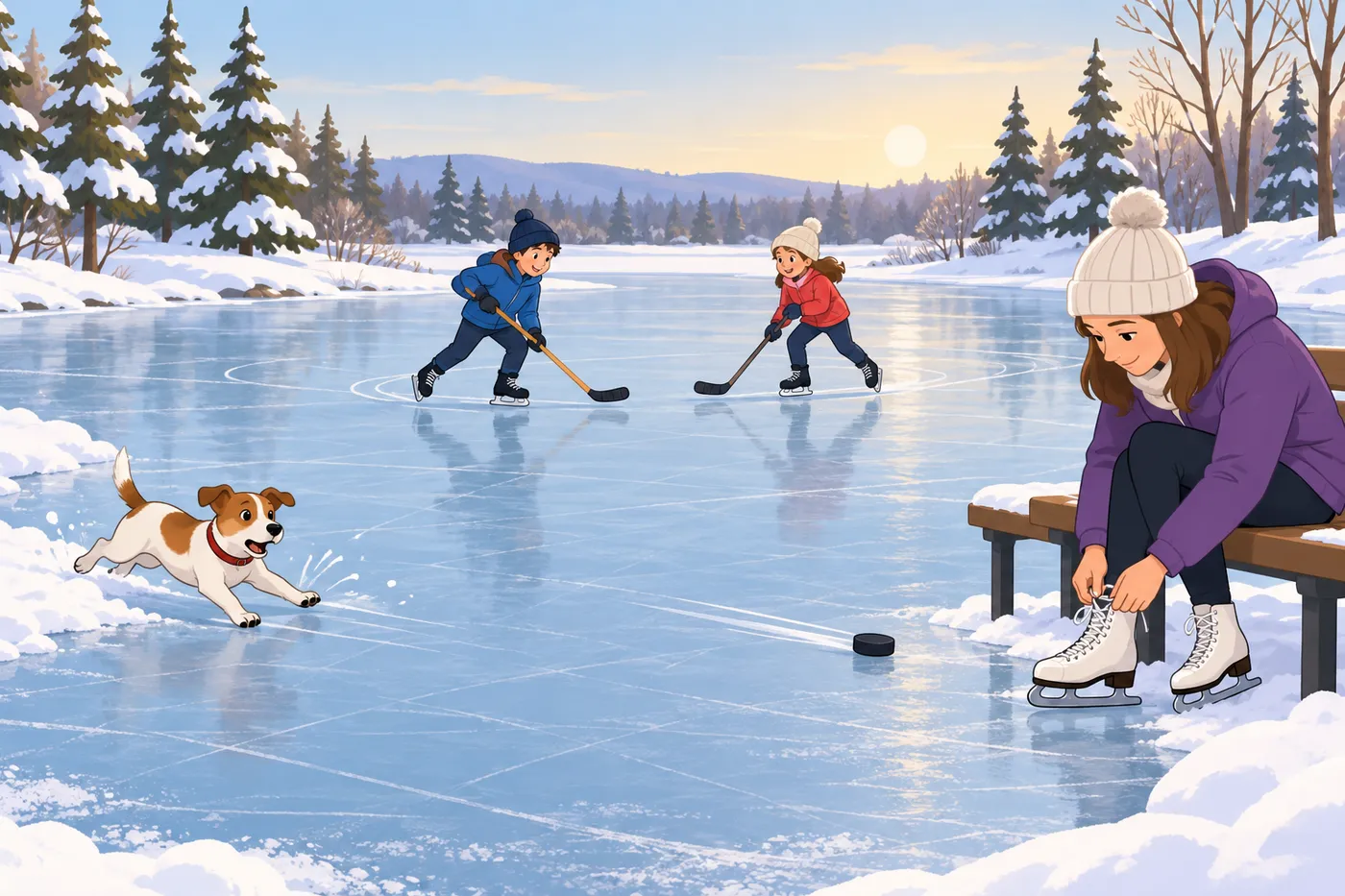
In this picture, what do you think will most probably happen next? Describe it as well as you can.
Sample answer (what the speaker says)
I think a few things are going to happen very soon at this frozen pond. First, the hockey puck is sliding fast across the ice, right toward the woman who's sitting on the bench and tying her skates. In a second, it's going to hit her skates. She'll probably be surprised, but I think she'll laugh, pick up the puck and throw it back to the two children. Second, the little brown and white dog is running onto the ice, but its legs are already sliding. I'm sure it's going to slip and fall. It might slide right into the middle of the hockey game, and the kids will probably stop playing to help it, or just laugh. After that, I think the woman will finish tying her skates and join the children. Maybe they'll play hockey together for a while. But the sun is going down, so it'll get dark and cold soon. By the end of the day, they'll most likely go home to warm up with some hot chocolate.
Why it works: Each prediction comes from a clue in the picture: the sliding puck and the dog's slipping legs, then the setting sun for what will happen later. The speaker uses many future forms ("is going to", "will probably", "might", "I'm sure", "most likely") and gives a reason for each prediction, with only a few words of description. It fills about 60 seconds.
Questions students ask
Is Task 4 the same picture as Task 3?
Yes. You describe the scene in Task 3, then predict what will happen next in the same scene in Task 4.
How long is CELPIP Speaking Task 4?
You get 30 seconds to prepare and 60 seconds to speak.
How many predictions should I make?
Two or three, each with a reason. That is enough to fill a minute and show a range of future forms.
What if I can't see anything about to happen?
Think about the people's plans: what they will do next, where they will go and how the scene will change later, like the end of the day or the weather.